01
Systems engineering
Requirements-driven architecture, interface control and configuration discipline across air vehicle and mission systems.


AeroCanada Industries 770 Inc.
From Canada’s aerospace tradition, AeroCanada is developing unmanned aircraft concepts that extend precision, coverage and operational flexibility for modern agricultural and special-mission aviation.
Heritage
Canada has long contributed to civil and commercial aviation through engineering discipline, regulatory rigor and a culture of operational reliability. That heritage shapes how AeroCanada approaches unmanned systems: methodical design, careful integration, and respect for the realities of flight.
Based in Montreal — within one of North America’s established aerospace corridors — AeroCanada Industries 770 Inc. brings an institutional aviation perspective to unmanned agricultural and special-mission concepts. Our work is grounded in aerospace practice: clear requirements, disciplined systems engineering, and transparent development status.
We do not treat unmanned aircraft as consumer gadgets. We treat them as aviation systems that must earn trust through engineering, validation and responsible program management.
Observation
Crewed agricultural aviation remains essential. Skilled pilots, proven airframes and established operating practices continue to serve large-scale crop protection and application missions with professionalism and experience that no new technology can casually replace.
At the same time, operators and institutions face evolving pressures: labour availability, mission repetition, access to complex terrain, consistency of application, and the need to match the right tool to the right field. Unmanned aircraft systems (UAS) are emerging as a complementary capability — not a substitute for crewed ag aviation, but an additional option where precision, persistence or access can be improved.
AeroCanada’s agricultural UAS concepts are designed to sit alongside existing aviation practice, offering platforms for programs that require coverage at scale or precision where it matters most.
“If we were designing an agricultural aircraft today, with access to modern autonomous flight, aerospace systems and remote supervision, would we still design it around a pilot sitting inside the aircraft?”The engineering question behind AeroCanada’s UAS program
Program family
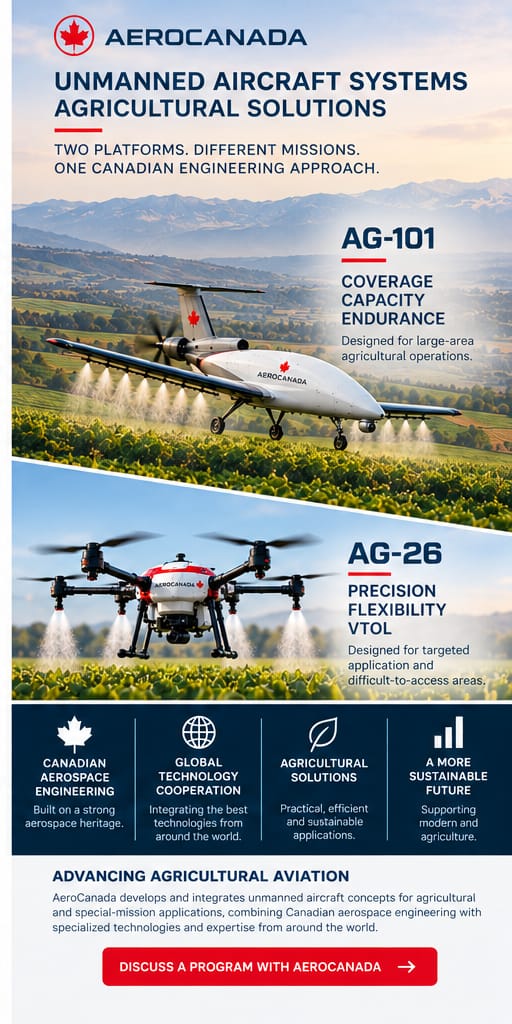
AeroCanada’s agricultural UAS family is organized around mission fit: large-area coverage on one side, targeted precision and access on the other — developed under a common Canadian engineering and integration philosophy.
Fixed-wing platform
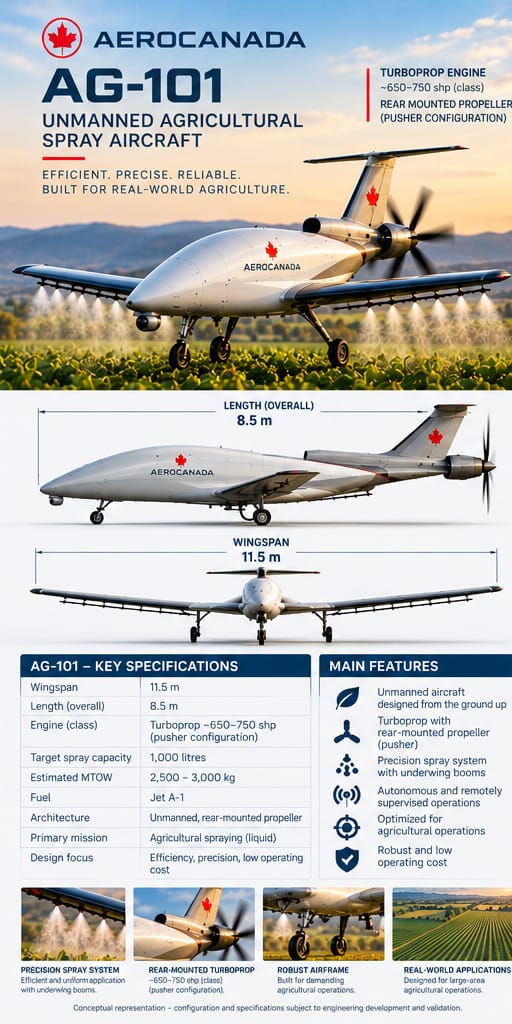
AG-101 is AeroCanada’s fixed-wing unmanned agricultural spray concept, oriented toward large-area operations where efficient coverage, meaningful payload capacity and mission endurance determine program value.
The platform architecture emphasizes a clean unmanned airframe, underwing spray application, and a rear-mounted propulsion layout suited to agricultural spray profiles. AG-101 is intended for programs that need to treat broad acreage with disciplined route planning and supervised autonomous operations.
Wingspan
11.5 m
Length
8.5 m
Target spray capacity
~1000 litres
Development targets subject to engineering validation. Figures shown are program targets, not certified or production specifications.
Multi-rotor platform
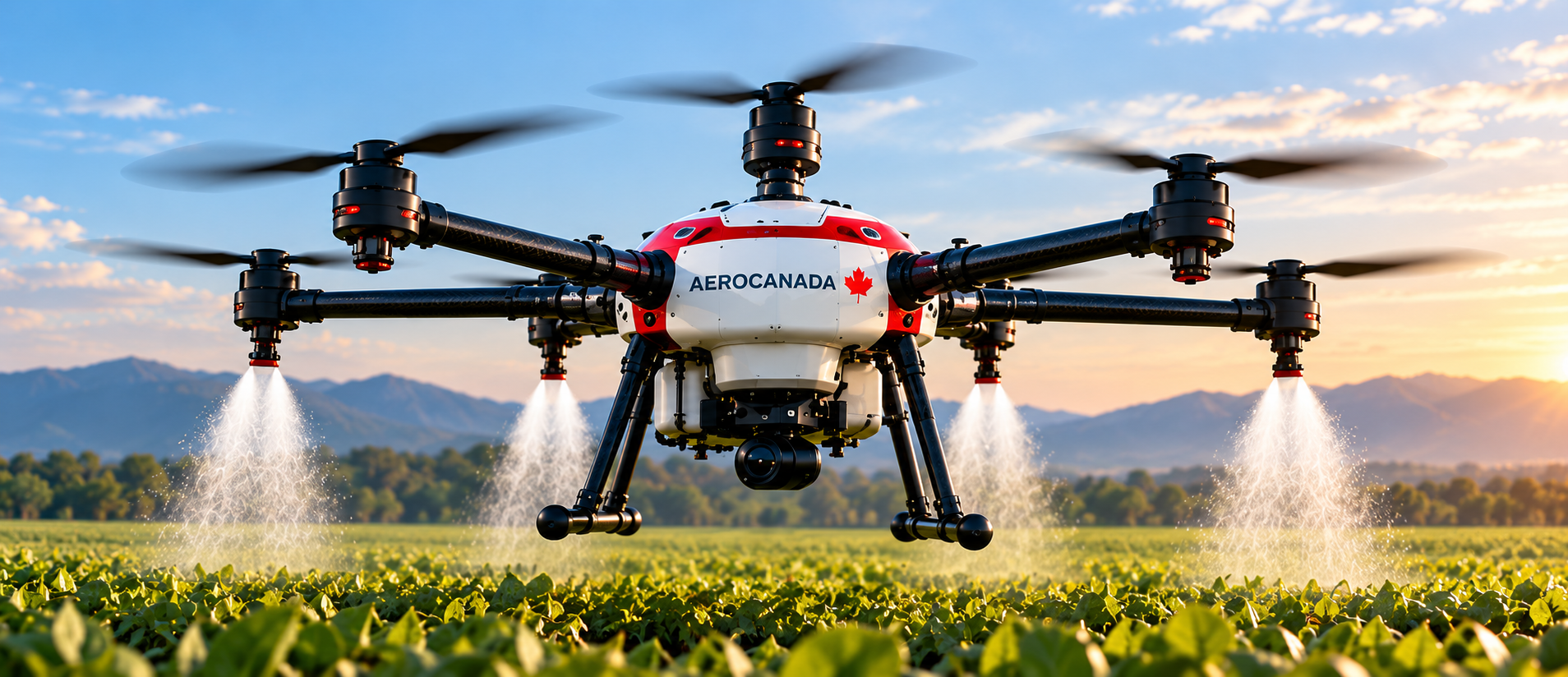
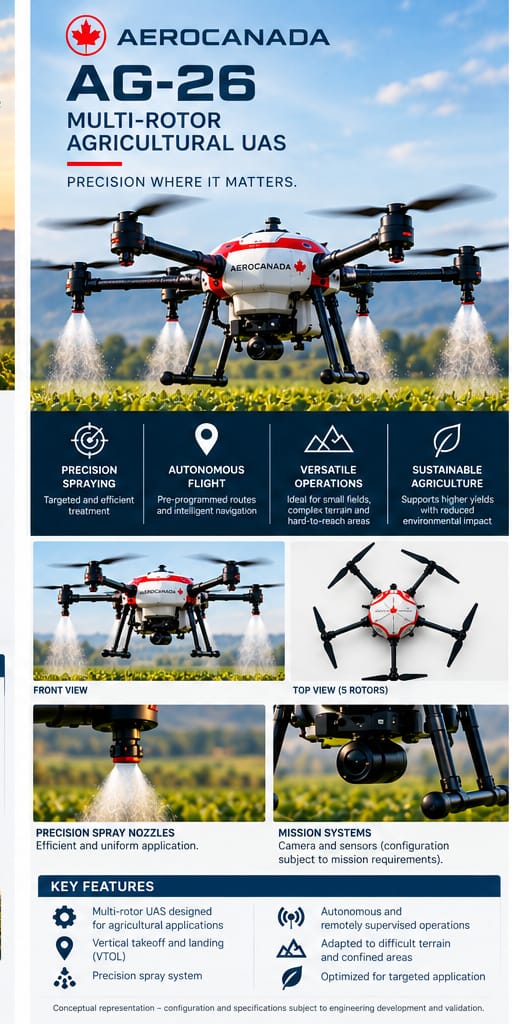
AG-26 is AeroCanada’s multi-rotor agricultural UAS concept, built around a five-rotor architecture and vertical takeoff and landing (VTOL) operations. It is intended for targeted application, confined or complex terrain, and missions where access and precision outweigh wide-area cruise efficiency.
Where AG-101 addresses coverage at scale, AG-26 focuses on the work that benefits from hovering stability, short-field access and fine control of application. The platform supports autonomous and remotely supervised mission profiles adapted to agricultural realities.
Method
Effective unmanned systems are rarely invented in isolation. AeroCanada’s approach combines carefully selected global technologies with Canadian systems integration, program discipline and aviation judgement.
We evaluate propulsion, avionics, guidance, spray systems and ground infrastructure as an integrated whole — then refine architecture against mission requirements, regulatory context and partner constraints. The objective is not novelty for its own sake; it is a coherent, supportable aircraft system.
Institutional strengths
Capabilities applied to unmanned agricultural and special-mission concepts — rooted in aerospace practice and partner-facing program delivery.
01
Requirements-driven architecture, interface control and configuration discipline across air vehicle and mission systems.
02
Selection and integration of global propulsion, avionics, guidance and application technologies under Canadian program oversight.
03
Concept development for coverage, precision application and access-constrained operations in real agricultural environments.
04
Structured engagement with government, industrial and institutional counterparts — from exploratory discussion to development roadmap.
AG-101 and AG-26 are presented as advanced development concepts. They are not certified aircraft, not production-ready products, and not offered for commercial sale on this page.
Visuals and figures illustrate intended architecture and development targets. Configuration, performance and specifications remain subject to engineering development, testing and validation. AeroCanada will communicate maturity milestones through appropriate institutional channels as programs progress.
Organizations seeking evaluation partnerships, demonstration frameworks or industrial cooperation are invited to discuss program scope and timing directly with AeroCanada.
Roadmap
Near-term work concentrates on architecture maturation, subsystem selection, integration planning and partner alignment for agricultural and special-mission use cases. Parallel activity includes refining operating concepts with institutional stakeholders and preparing verification pathways consistent with regulatory expectations.
Medium-term horizons focus on progressive demonstration — ground validation, controlled flight activity and mission-relevant evaluation — timed to partner readiness rather than marketing calendars. Longer-term production or certification pathways, if pursued, will be defined only after engineering validation and program agreements justify that step.
AeroCanada’s priority is durable engineering progress over premature claims.
Engagement
Five pillars for structured cooperation with public institutions, industrial partners and agricultural stakeholders.
Structured assessment of UAS concepts against defined mission requirements and operating constraints.
Program frameworks that explore coverage and precision application as complements to existing ag aviation practice.
Collaboration on subsystems, integration, manufacturing readiness and supply-chain participation.
Joint development of CONOPS, supervision models and ground infrastructure assumptions for real-world use.
Exploration of adjacent unmanned mission profiles that share agricultural aviation engineering foundations.
Government agencies, industrial partners and institutional stakeholders are invited to engage AeroCanada on unmanned agricultural and special-mission program opportunities.
Contact
Share your organization and program interest. AeroCanada will respond through institutional channels.